Training catalogue

2 trainings match your filters

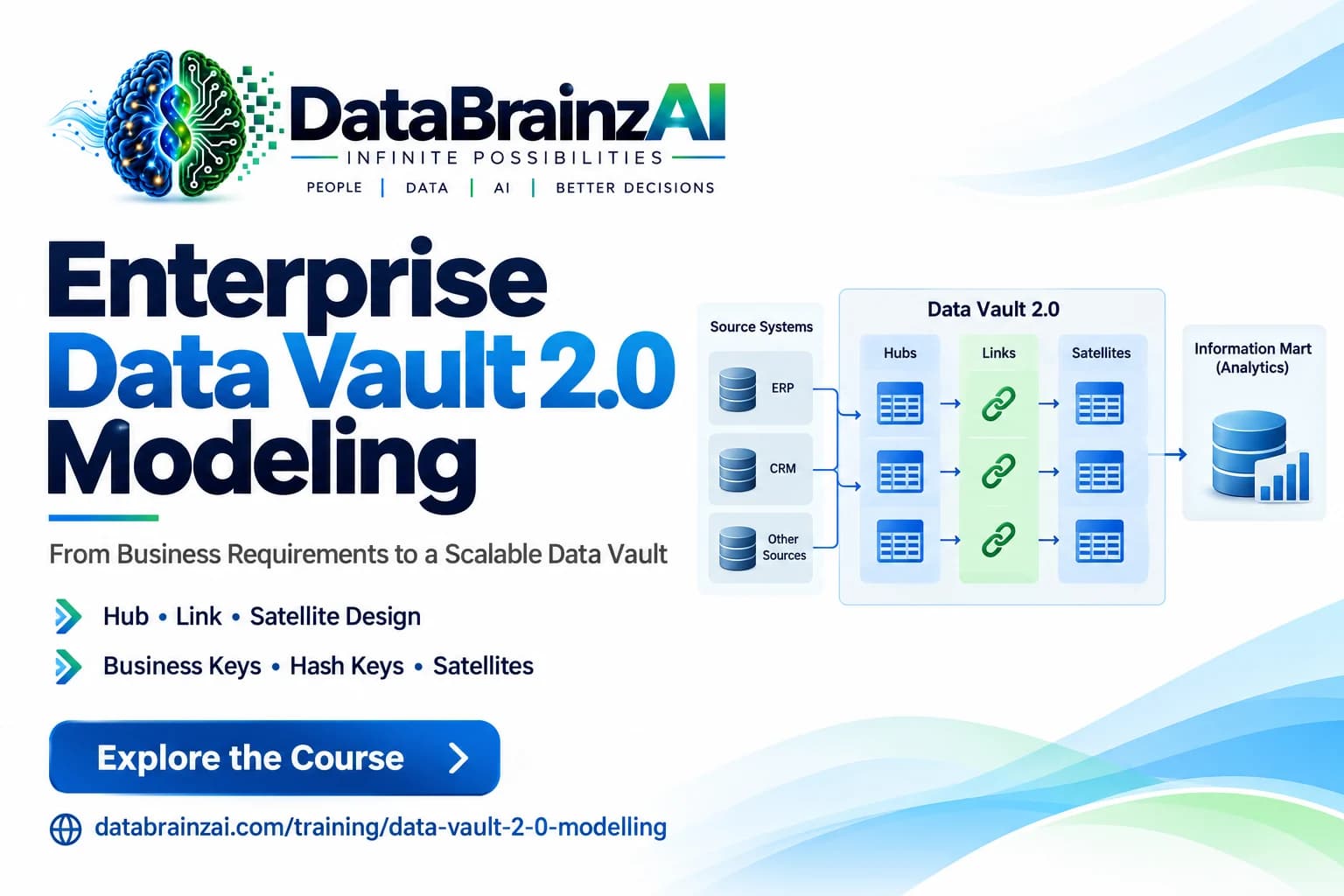
Enterprise Data Vault 2.0 Modeling
Data Vault 2.0Advanced

Enterprise Data Vault 2.0 Modeling

Design enterprise-grade data vault 2.0 models, from business requirements and source system analysis to raw vault, business vault and information marts. design hub, link and satellite, keys, historization, PIT tables, bridges and advanced modeling patterns. real business scenarios.

Duration
30 hrs
Mode
Live online
Starts
26 Oct 2026
Syllabus · 15 modules · Weekends, 10am–2pm IST
  1. Enterprise Data Vault 2.0 Architecture · 2h

    OBJECTIVE:

    • Understand the principles, components and architectural layers of Data Vault 2.0.

    TOPICS:

    • Evolution of enterprise data warehousing

    • Data Vault 1.0 versus Data Vault 2.0.

    • Data Vault 2.0 architecture and its three pillars: modeling, methodology and architecture

    • Raw Vault, Business Vault and Information Marts

    • Data Vault in modern cloud data platforms

    • Data integration, scalability, auditability and agility

    PRACTICAL EXCERCISES:

    • Design a high-level Data Vault architecture for a banking enterprise

    ASSESSMENT:

    • Identify the responsibilities of each architectural layer.

  2. Business Requirements and Source System Analysis · 2h

    OBJECTIVE:

    • Translate business requirements and source system structures into Data Vault modeling requirements

    TOPICS:

    • Business processes, business rules and business concepts

    • Identifying business entities and their relationships

    • Business keys versus technical keys

    • Source system profiling and metadata analysis

    • Identifying master, transactional, reference and event data

    • Source-to-business concept mapping

    • Identifying data integration challenges

    PRACTICAL EXCERCISES:

    • Analyze customer, account and transaction source systems and identify candidate Hubs, Links and Satellites

    ASSESSMENT:

    • Prepare a business-to-source mapping document.

  3. Data Vault 2.0 Modeling Fundamentals · 2h

    OBJECTIVE:

    • Understand the core modeling principles and establish enterprise modeling standards

    TOPICS:

    • Business keys and their stability

    • Hash keys and hash differences

    • Hub, Link and Satellite fundamentals

    • Insert-only modeling and historical preservation

    • Naming conventions and modeling standards

    • Logical versus physical Data Vault models

    • Standard metadata and audit columns

    PRACTICAL EXCERCISES:

    • Create a basic logical model for customer and account data.

    ASSESSMENT:

    • Review the model for correct business key and object classification.

  4. Enterprise Hub Modeling · 2h

    OBJECTIVE:

    • Design enterprise Hubs using business keys and integrate multiple source systems.

    TOPICS:

    • Hub identification and design principles

    • Business key selection and standardization

    • Composite and concatenated business keys

    • Enterprise versus source-specific business keys

    • Hub relationships and business domains

    • Hub integration across multiple source systems

    • Hub metadata and audit attributes

    • Handling missing and invalid business keys

    PRACTICAL EXCERCISES:

    • Design Customer, Account, Product, Employee and Transaction Hubs for a financial services organization.

    ASSESSMENT:

    • Evaluate Hub design against enterprise modeling standards.

  5. Enterprise Link Modeling · 2h

    OBJECTIVE:

    • Model relationships among enterprise business concepts using Links.

    TOPICS:

    • Link identification and design principles

    • Transactional and non-transactional Links

    • Standard, dependent-child and hierarchical relationships

    • Composite business relationships

    • Link cardinality and relationship constraints

    • Multi-source relationship integration

    • Link granularity and modeling decisions

    • Link naming and metadata standards

    PRACTICAL EXCERCISES:

    • Model customer-account, account-transaction, customer-product and employee-organization relationships.

    ASSESSMENT:
    - Validate Link grain, participating Hubs and business meaning.

  6. Enterprise Satellite Modeling · 2h

    OBJECTIVE:

    • Design Satellites for descriptive attributes, history and source-specific data.

    TOPICS:

    • Satellite identification and design

    • Hub Satellites and Link Satellites

    • Source-aligned and business-aligned Satellites

    • Satellite splitting and grouping strategies

    • Attribute historization and change tracking

    • HashDiff design and change detection

    • Load date, record source and audit attributes

    • Satellite granularity and naming standards

    PRACTICAL EXCERCISES:

    • Design customer profile, account status, transaction details and customer risk Satellites.

    ASSESSMENT:

    • Review Satellite separation, historization and attribute placement.

  7. Advanced Data Vault Modeling Patterns · 2h

    OBJECTIVE:

    • Apply advanced Data Vault structures to complex enterprise scenarios.

    • TOPICS: Multi-Active Satellites

    • Same-as Links and identity resolution

    • Hierarchical Links and recursive relationships

    • Non-Historized Links

    • Effectivity Satellites

    • Status tracking and relationship lifecycle

    • Dependent-child relationships

    • Choosing appropriate modeling patterns

    PRACTICAL EXCERCISES:

    • Model multiple customer addresses, account ownership changes, customer identity matching and organizational hierarchies.

    ASSESSMENT:

    • Select and justify modeling patterns for given business scenarios.

  8. Historical Data and Temporal Modeling · 2h

    OBJECTIVE:

    • Model historical changes, effective dates and temporal relationships.

    TOPICS:

    • Historical data preservation

    • Load time versus business effective time

    • Valid-time and transaction-time concepts

    • Late-arriving and out-of-order data

    • Retroactive corrections

    • Relationship effectivity

    • Handling deleted and deactivated records

    • Historical reconstruction and point-in-time analysis.

    PRACTICAL EXCERCISES:

    • Model customer address changes, account closures and backdated transaction corrections.

    ASSESSMENT:

    • Design a temporal model for a changing customer-account relationship.

  9. Raw Vault Architecture and Modeling · 2h

    OBJECTIVE:

    • Build an integrated Raw Vault model from heterogeneous source systems.

    TOPICS:

    • Raw Vault principles and design standards

    • Source-aligned modeling

    • Multi-source data integration

    • Raw Vault object dependencies

    • Load sequencing and dependency management

    • Data lineage and traceability

    • Record source and audit requirements.

    PRACTICAL EXCERCISES:

    • Build a Raw Vault model using customer and account data from multiple banking systems.

    ASSESSMENT:

    • Review the complete Raw Vault logical model and its source traceability.

  10. Business Vault Modeling · 2h

    OBJECTIVE:

    • Design Business Vault structures to implement reusable business rules and derived data.

    TOPICS:

    • Business Vault architecture and design principles

    • Raw versus derived business information

    • Business rules and transformation logic

    • Derived and computed Satellites

    • Business effectivity and calculated relationships

    • Business key resolution and survivorship

    • Rule versioning and historical recalculation

    • Reusable business logic.

    PRACTICAL EXCERCISES:

    • Design Business Vault objects for customer classification, account risk and consolidated customer identity.

    ASSESSMENT:

    • Classify business rules and map them to suitable Business Vault structures.

  11. PIT Tables and Bridge Tables · 2h

    OBJECTIVE:

    • Design PIT and Bridge structures to simplify point-in-time queries and complex relationship navigation.

    TOPICS:

    • Purpose and architecture of PIT tables

    • Snapshot, full-history, rolling and incremental PIT patterns

    • Satellite selection and effective record lookup

    • PIT refresh and maintenance strategies

    • Bridge table design and relationship traversal

    • Hierarchical and recursive Bridge tables

    • Performance and storage considerations

    • Virtual versus materialized access structures.

    PRACTICAL EXCERCISES:

    • Design a Customer PIT, Account PIT and customer-account Bridge for reporting requirements

    ASSESSMENT:

    • Select appropriate PIT and Bridge patterns for different query scenarios.

  12. Data Vault to Dimensional Modeling · 2h

    OBJECTIVE:

    • Transform integrated Data Vault structures into reporting-ready dimensional models.

    TOPICS:

    • Information Mart architecture

    • Data Vault versus dimensional modeling

    • Identifying fact table grain

    • Transaction, periodic snapshot and accumulating snapshot facts

    • Dimension design and surrogate keys

    • Slowly Changing Dimensions

    • Handling many-to-many relationships

    • Mapping Hubs, Links and Satellites to dimensions and facts

    • Historical and current-state reporting.

    PRACTICAL EXCERCISES:

    • Design a banking dimensional model for account balances, transactions and customer activity using the Data Vault as the source.

    ASSESSMENT:

    • Validate fact grain, dimension relationships and historical reporting requirements.

  13. Physical Data Vault Design and Implementation · 2h

    OBJECTIVE:

    • Convert logical Data Vault models into implementation-ready physical designs.

    TOPICS:

    • Logical-to-physical model transformation

    • Database-specific data types and naming standards

    • Primary keys, foreign keys and indexing strategies

    • Hash key and HashDiff implementation considerations

    • Partitioning and clustering strategies

    • Audit columns and technical metadata

    • Physical modeling in ER/Studio or ERwin | Platform-specific design considerations for Oracle, Snowflake and SQL Server

    PRACTICAL EXCERCISES:

    • Generate physical tables and DDL from selected logical Data Vault models.

    ASSESSMENT:

    • Review physical model consistency and implementation readiness.

  14. Enterprise Data Vault Modeling Standards and Governance · 2h

    OBJECTIVE:

    • Establish enterprise-wide modeling standards, quality controls and governance practices.

    TOPICS:

    • Enterprise modeling standards and reusable patterns

    • Model naming and documentation conventions

    • Business glossary and metadata management

    • Model versioning and change management

    • Source-to-target mapping and data lineage

    • PII classification and data protection metadata

    • Data quality rules and model validation

    • Model review checklists and design governance

    PRACTICAL EXCERCISES:

    • Create a modeling standards document and perform a peer review of an enterprise Data Vault model.

    ASSESSMENT:

    • Conduct a structured model quality review.

  15. Enterprise Data Vault Capstone Project · 2h

    OBJECTIVE:

    • Apply the course concepts to design a complete enterprise Data Vault solution.

    CASE STUDY:

    • Global Financial Services Data Warehouse

    PROJECT ACTIVITIES:

    • Analyze business requirements

    • Identify business keys, entities and relationships

    • Map source systems to enterprise business concepts

    • Design the Raw Vault with Hubs, Links and Satellites

    • Apply advanced modeling patterns

    • Design Business Vault structures

    • Design PIT and Bridge tables

    • Develop dimensional Information Marts

    • Prepare source-to-target mappings and data lineage

    • Create model documentation.

    DELIVERABLES:

    • Enterprise Data Vault architecture diagram

    • Business process and source mapping

    • Complete logical Data Vault model

    FINAL ASSESSMENT:

    • Present and defend the enterprise model, explain key design decisions and respond to a technical model review.

You will be able to:
  • Analyze complex business requirements and translate them into enterprise Data Vault 2.0 models.

  • Identify business keys, define business concepts and design Hubs, Links and Satellites.

  • Design Raw Vault architectures that integrate data from multiple source systems.

  • Apply appropriate historization, change tracking and auditability strategies.

  • Model complex relationships, including many-to-many relationships, hierarchies and recursive relationships.

  • Design advanced Data Vault structures, including Multi-Active Satellites, Same-as Links, PIT tables and Bridge tables.

  • Distinguish between Raw Vault, Business Vault and Information Mart responsibilities.

  • Design Business Vault structures using derived data, business rules and calculated attributes.

  • Develop source-to-target mappings and define data lineage and load dependencies.

  • Design dimensional Information Marts using Data Vault as the underlying integration layer.

  • Evaluate modeling alternatives for scalability, flexibility, performance and maintainability.

  • Produce a complete enterprise Data Vault 2.0 logical model and its supporting design documentation.

₹13,587₹15,985per participant, + GST
Early Bird Offer · 15% off
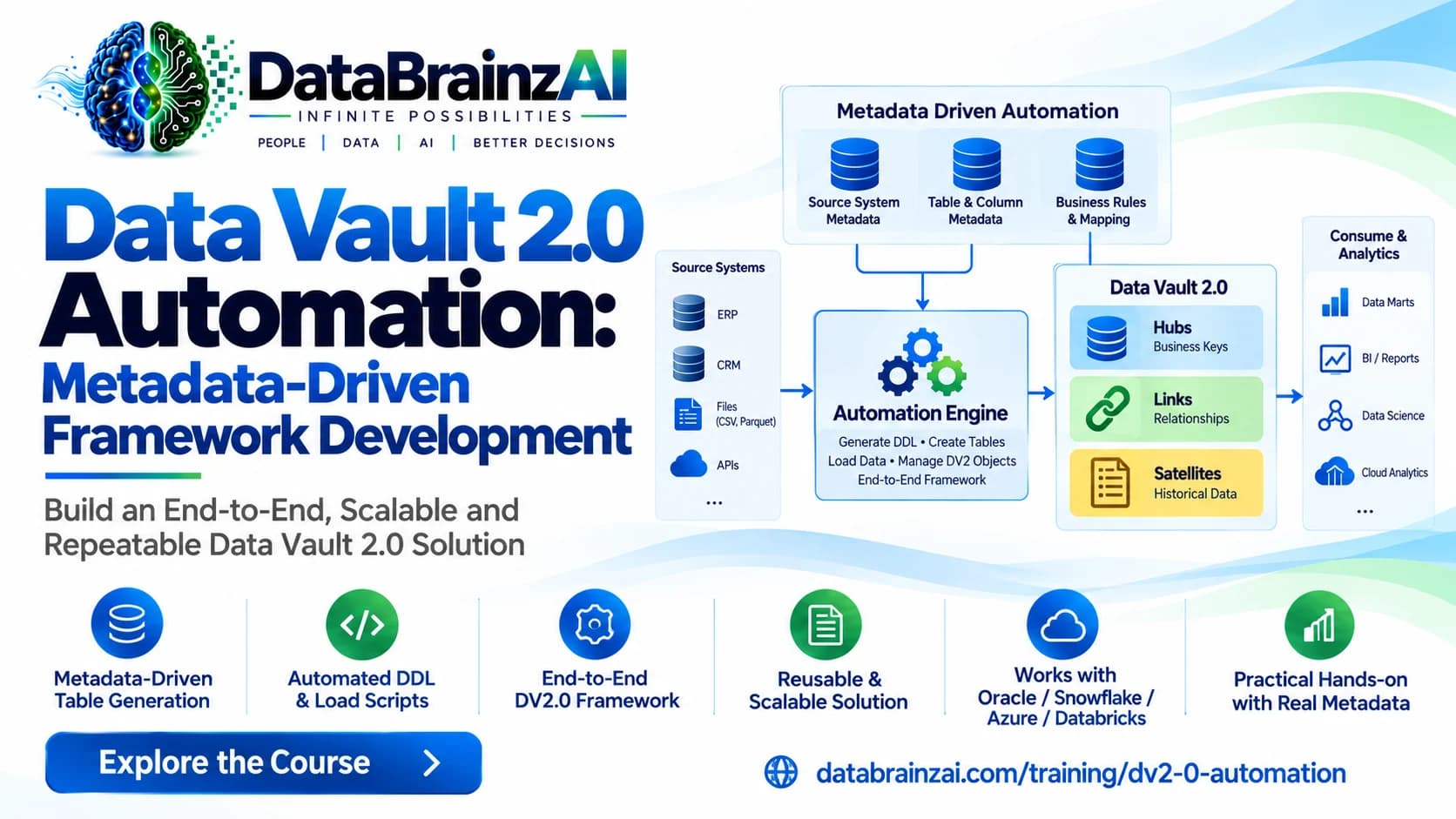
Data Vault 2.0 Automation: Metadata-Driven Framework Development
Data Vault 2.0Advanced

Data Vault 2.0 Automation: Metadata-Driven Framework Development

Build an end-to-end, metadata-driven Data Vault 2.0 automation framework using Snowflake SQL and Python. Automate data vault tables, metadata management, source ingestion, Hash Key & HashDiff generation, and ETL execution. Develop a reusable automation framework through practical exercises.

Duration
30 hrs
Mode
Live online
Starts
30 Oct 2026
Syllabus · 15 modules
  1. Data Vault 2.0 Automation Architecture · 2h

    Objective:

    • understand the architecture and components of a metadata-driven automation framework.

    Topics:

    • data vault 2.0 implementation lifecycle

    • manual versus automated data vault development

    • metadata-driven architecture and design principles

    • automation framework components

    • source, landing, bronze, raw vault and business vault layers

    • SQL and python responsibilities

    • framework configuration and execution flow.

    Practical Excercises:

    • design an end-to-end automation architecture and define its components.

    Deliverable:

    • automation architecture diagram.

  2. Metadata Repository Design · 2h

    OBJECTIVE:

    • design metadata structures that drive automated data vault development.

    TOPICS:

    • metadata repository architecture

    • source system and source object metadata

    • file format and stage metadata

    • table and column metadata

    • hub, link and satellite configuration

    • business key and hashdiff metadata

    • load configuration and execution status

    • metadata naming standards and relationships

    PRACTICAL EXCERCISES:

    • create metadata tables such as:

    • GTE_METADATA_SOURCE_SYSTEM

    • GTE_METADATA_FILE_FORMAT

    • GTE_METADATA_STAGE_LOAD

    • metadata tables for columns, hubs, links and satellites.

    DELIVERABLE:

    • metadata repository with sample configurations.

  3. Metadata Extraction and Management · 2h

    OBJECTIVE:

    • extract database metadata and populate the automation repository.

    TOPICS:

    • database catalog and information schema

    • extracting tables, columns and data types

    • primary key and foreign key metadata

    • metadata validation and synchronization

    • source-to-target metadata mapping

    • dynamic SQL generation from metadata

    • metadata-driven configuration management

    PRACTICAL EXCERCISES:

    • develop SQL scripts to extract source table and column metadata and populate the repository.

    DELIVERABLE:

    • automated metadata extraction scripts.

  4. Python Automation Framework · 2h

    OBJECTIVE:

    • develop a reusable python framework for executing metadata-driven automation.

    TOPICS:

    • python project structure and modular design

    • snowflake python connector

    • connection management and environment variables

    • reading metadata from snowflake

    • executing SQL dynamically

    • parameterized scripts and reusable functions

    • logging, configuration and exception handling

    • master execution program.

    PRACTICAL EXCERCISES:

    • develop python modules for connecting to snowflake, retrieving metadata and executing SQL scripts.

    DELIVERABLE:

    • reusable python execution framework.

  5. Automated File Ingestion and Landing Layer · 2h

    OBJECTIVE:

    • automate source file ingestion and landing table creation.

    TOPICS:

    • snowflake internal and external stages

    • automated file format creation

    • CSV, JSON and Parquet file handling

    • stage creation using metadata

    • file discovery and validation

    • LIST, PUT and COPY INTO

    • file patterns and incremental file processing

    • landing table generation and load auditing.

    PRACTICAL EXCERCISES:

    • develop python and SQL scripts to create stages, file formats and landing tables, then load source files.

    DELIVERABLE:

    • metadata-driven file ingestion framework.

  6. Automated Bronze Layer Generation · 2h

    OBJECTIVE:

    • automate bronze table creation and ingestion using source metadata.

    TOPICS:

    • bronze layer architecture and design | source-to-bronze mapping

    • automated table DDL generation

    • dynamic column and data type mapping

    • audit and technical columns

    • source system identifiers

    • file name, load timestamp and record tracking

    • bronze layer validation and reconciliation.

    PRACTICAL EXCERCISES:

    • build a python generator that reads metadata and creates bronze tables and corresponding load scripts.

    DELIVERABLE:

    • reusable bronze table generator.

  7. Automated Hub Generation · 2h

    OBJECTIVE:

    • generate hub tables and loading logic automatically from metadata.

    TOPICS:

    • hub metadata requirements | business key identification and configuration

    • hash key generation

    • hub DDL generation

    • record source and load timestamp

    • dynamic SQL for hub loading

    • duplicate detection and insert-only loading

    • multi-source hub integration.

    PRACTICAL EXCERCISES:

    • build a metadata-driven hub generator and load customer and account hubs.

    DELIVERABLE:

    • hub DDL and load automation modules.

  8. Automated Link Generation · 2h

    OBJECTIVE:

    • automate link table creation and loading using relationship metadata.

    TOPICS:

    • link metadata design

    • hub relationship configuration

    • link Hash Key generation

    • foreign key resolution

    • standard and dependent-child Links

    • dynamic link DDL generation

    • link loading and duplicate prevention

    • handling missing Hub records.

    PRACTICAL EXCERCISES:

    • develop a link generator for customer-account and account-transaction relationships.

    DELIVERABLE:

    • automated link generation and loading scripts.

  9. Automated Satellite Generation · 2h

    OBJECTIVE:

    • automate satellite DDL and loading logic for historical data management.

    TOPICS:

    • satellite metadata and attribute configuration

    • hub, link and satellite generation

    • hashdiff generation

    • satellite DDL generation

    • change detection and incremental loading

    • insert-only historization

    • handling nulls and changed attributes

    • multi-source and source-aligned satellites.

    PRACTICAL EXCERCISES:

    • build a satellite generator and automate customer profile and account status loading.

    DELIVERABLE:

    • reusable satellite generator and load framework.

  10. Automated Raw Vault Loading · 2h

    OBJECTIVE:

    • integrate hub, link and satellite loading into a configurable raw vault pipeline.

    TOPICS:

    • raw vault load sequence

    • metadata-driven dependency management

    • hub, link and satellite execution order

    • incremental loading and change detection

    • late-arriving records

    • transaction handling and restartability

    • load reconciliation and record counts

    • load status and audit management.

    PRACTICAL EXCERCISES:

    • build an automated Raw Vault loader that executes the generated scripts in the correct order.

    DELIVERABLE:

    • end-to-end raw vault loading engine.

  11. Business Vault Automation · 2h

    OBJECTIVE:

    • extend the automation framework to support derived structures and business rules.

    TOPICS:

    • business vault metadata requirements

    • derived satellite generation

    • business rule configuration

    • calculated attributes and transformations

    • effectivity processing

    • business key resolution

    • automated business vault DDL generation

    • dependency management for derived objects.

    PRACTICAL EXCERCISES:

    • Configure and generate a derived Satellite for customer classification using business rules.

    DELIVERABLE:

    • Business Vault automation design and sample scripts.

  12. PIT and Bridge Table Automation · 2h

    OBJECTIVE:

    • automate the generation and maintenance of PIT and bridge structures.

    TOPICS:

    • PIT and bridge metadata

    • PIT table DDL generation

    • satellite dependency configuration

    • snapshot and incremental PIT loading

    • bridge relationship metadata

    • bridge table generation and refresh

    • historical point-in-time retrieval

    • performance and maintenance considerations.

    PRACTICAL EXCERCISES:

    • Generate a customer PIT and a customer-account Bridge from metadata.

    DELIVERABLE:

    • PIT and bridge automation modules.

  13. Metadata-Driven Orchestration · 2h

    OBJECTIVE:

    • build a centralized execution engine to control the complete automation pipeline.

    TOPICS:

    • master execution framework

    • configuration-driven processing

    • pipeline dependency management

    • sequential and parallel execution

    • task status and execution logs

    • retry and restart mechanisms

    • failure handling and notifications

    • integration with scheduling tools.

    PRACTICAL EXCERCISES:

    • develop a master python program that executes ingestion, bronze generation, raw vault loading

    • downstream processing based on metadata.

    DELIVERABLE:

    • centralized orchestration framework.

  14. Automation Testing, Auditing and Optimization · 2h

    OBJECTIVE:

    • implement quality controls and operational capabilities for the automation framework.

    TOPICS:

    • metadata validation

    • generated SQL validation

    • data quality and reconciliation

    • duplicate and missing record checks

    • exception and error logging

    • audit tables and execution history

    • performance optimization

    • secure configuration and credentials

    • unit and integration testing.

    PRACTICAL EXCERCISES:

    • introduce error handling, audit logging and validation into the existing automation framework.

    DELIVERABLE:

    • tested automation components and operational monitoring design.

  15. End-to-End Data Vault Automation Project · 2h

    OBJECTIVE:

    • Integrate course modules into a working metadata-driven data vault automation solution

    BUSINESS SCENARIO:

    • a financial organization receives customer, account, order, trade and portfolio data from multiple source systems.

    • objective is to automate ingestion, bronze creation and data vault loading through a centralized metadata.

    PROJECT ACTIVITIES:

    1. configure file metadata

    2. extract table and column metadata

    3. generate stages, file formats and landing tables

    4. generate bronze tables and ingestion scripts

    5. generate hub, link and satellite DDL

    6. automate hash key and hashdiff generation

    7. execute raw vault loading

    8. implement audit logging and error handling

    9. configure master execution program

    10. run the complete pipeline and validate the results.

    FINAL DELIVERABLES:

    • metadata repository

    • python automation framework

    • automated DDL generators

    • hub, link and satellite loaders

    • master execution program

    • audit and validation scripts

You will be able to:
  • Design a metadata-driven Data Vault 2.0 automation architecture.

  • Create metadata tables to store source, file, object and loading configurations.

  • Automate source metadata extraction and landing table generation.

  • Develop reusable SQL and Python scripts to generate Data Vault database objects.

  • Automate Hub, Link and Satellite DDL generation.

  • Generate Hash Keys and HashDiffs using standardized metadata-driven rules.

  • Automate data ingestion and Raw Vault loading.

  • Implement incremental processing, historization and duplicate detection.

  • Build a metadata-driven execution engine for managing pipeline dependencies.

  • Implement audit logging, exception handling and restartability.

  • Integrate individual automation components into an end-to-end framework.

  • Extend the framework to support additional source systems and business domains.

₹29,985per participant, + GST