Infinite possibilities · People | Data | AI | Better decisions

Faster data platforms. AI drafts. Experts decide.

DataBrainzAI helps organisations and professionals design, build, modernise and optimise data platforms. AI speeds up the repetitive work. Experienced data architects make the decisions that matter, and your data stays protected.

AI assistsevery stageHuman gateevery decision
Live delivery lineageAI draftApproved
Requirements to production, with a human approval gate after every AI-assisted stageAI DRAFTRequirementsSign-offAI DRAFTArchitectureApprovalAI DRAFTData modelModel reviewAI DRAFTSTTM + codeCode reviewAI DRAFTTestingUAT + releaseLIVEProduction
Hover or tap any stepGreen steps are drafted with AI. Blue diamonds are human approval gates. Nothing reaches production without passing all of them.
  1. BUSINESS
  2. REQUIREMENTS
  3. DATA ARCHITECTURE
  4. DATA MODELING
  5. DATA PLATFORM
  6. DATA ENGINEERING
  7. DATA QUALITY
  8. GOVERNANCE
  9. ANALYTICS
  10. AI
  11. BETTER DECISIONS
How we work

AI for speed. People for judgement. Both for quality.

We use AI where it is reliably useful: repetitive, pattern-based, well-checked work. People stay in charge wherever a mistake would affect your data, your customers or your business decisions. Pick a stage to see the split.

AI assists with

Summarising documents and meeting notes; drafting a requirements catalogue and glossary.

Human expert decides

Business analyst confirms scope, rules and priorities with your stakeholders.

Gate before the next stage: Requirements sign-off
Guardrails

What AI never does on its own at DataBrainzAI

AI assistants make teams faster on average, but even the best agents still get a meaningful share of real enterprise data tasks wrong. Human review is what turns AI speed into reliable delivery.

  • DENYDeploy anything to production
  • DENYAccess, move or delete personal or sensitive data
  • DENYMake architecture or technology decisions
  • DENYChange business rules or data definitions
  • DENYApprove its own output
Who we serve

Built for the people who build with data.

Organisations

Build or modernise your data platform

  • New platforms, Data Vault, Data Warehouse
  • Cloud migration and modernisation
  • Data quality and governance
  • Introducing AI into data solutions safely
Architecture and platform services
Engineering teams

Level up on modern platforms and AI-assisted engineering

  • Snowflake, Databricks, Fabric, Azure, AWS
  • Modeling, Data Vault, SQL, Python
  • Reviewing AI-generated code and models
  • Workshops, bootcamps, architecture clinics
Team skills programs
Students and professionals

Move into modeling, architecture or Data + AI roles

  • Skill assessment and gap analysis
  • Portfolio projects that hold up in interviews
  • Mock interviews and 1:1 mentoring
  • A learning roadmap you can actually follow
Explore career paths
Services

Six services, one delivery discipline.

Each service shows where AI helps and where a qualified person stays in control.

01 · Architecture Solutions

Design the right data architecture before building the platform.

We align business requirements, data requirements, technology and future scale. AI helps us analyse your current state and compare options quickly. Our architects make and own the recommendation.

Enterprise Data Architecture

Business, domain, integration and analytical architecture, Data Mesh considerations, governance.

Data Platform Architecture

Snowflake, Microsoft Fabric, Databricks, Azure, AWS, streaming, metadata and quality platforms.

Data Vault 2.0

Raw and Business Vault, Hubs, Links, Satellites, PIT, Bridge, Effectivity Satellites, lineage.

Data Warehouse

Kimball dimensional modeling, conformed dimensions, SCDs, data marts, semantic models.

Cloud Data Architecture

Strategy, migration, ingestion, storage, processing, security, governance, cost optimisation.

AI-Ready Architecture

Semantic layers, retrieval (RAG), access controls on what AI can see, monitoring.

AreaAI helps withHuman control
Domain mappingSummarises documents and system inventories into a first-cut domain mapArchitect validates with business and IT owners
Platform selectionStructured comparison against your workloads and costsArchitect makes the final call
Data Vault designSuggests candidate business keys and hub/link structuresModeler validates each against the business
Migration sizingScans legacy schemas and job inventoriesArchitect confirms scope and risks

You receive: architecture diagrams, decision records, technology comparison, indicative cost model and roadmap, reviewed and signed by an architect.

Discuss your architecture
Technology trainings

Attend Free: 3 hours webinar on Sunday (11 Oct 2026)

Automation of Data Modeling from Source to E-R to Data Vault 2.0 to Dimensional Modeling using Python + AI. Timing: 10 am to 1 pm.

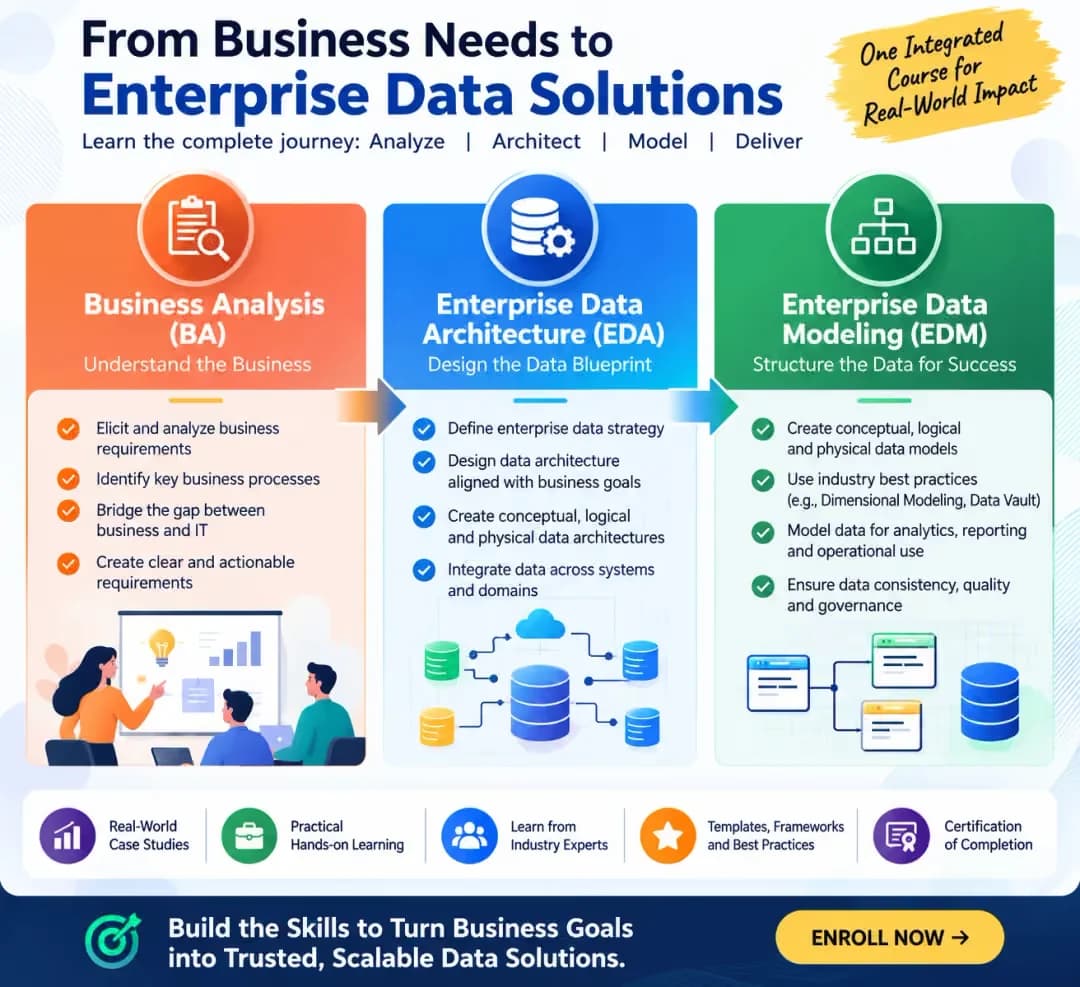
BA -> EDA -> EDM
Enterprise Data ArchitectureAdvanced

Business Requirement to Enterprise Data Architecture

Enables experienced data engineers to solve multiple business problems of different roles like: Business Analyst (Requirement Gathering) | Data Architecture (Design Data Layers), | Data Modeler (Design Data Structures)

with the help of AI as the core executor.

Duration
32 hrs
Mode
Live online
Starts
14 Nov 2026
Syllabus · 8 modules · Sat-Sun | 7 to 9 pm
  1. Business Requirements & Analysis · 3h
    • Introduction to enterprise data architecture

    • Business requirements versus functional and non-functional requirements

    • Role of the Business Analyst, Data Architect, Data Modeler and Data Engineer

    • Relationship between business architecture, application architecture and data architecture

    • Challenges in translating business language into technical solutions

    • Requirement gathering techniques

    • Business requirement documents (BRDs)

    • Functional and non-functional requirements

    • Business process identification

    • Business scenarios, use cases and user stories

    • Requirement classification and prioritization

    • Requirement ambiguity, duplication, inconsistency and gaps

    • Business events and their lifecycle

    • Business rules and decision points

    • Operational versus analytical requirements

  2. Business-to-Data Requirements · 3h
    • Business domains and subdomains

    • Data domain ownership

    • Master, reference, transactional and event data

    • Cross-domain data dependencies

    • Translating business activities into data requirements

    • Business objects versus data entities

    • Identifying data capture, update, retrieval and reporting requirements

    • Data attributes and business definitions

    • Data ownership and authoritative sources

    • Data retention and historical requirements

    • Operational, analytical and regulatory data needs

    • Source system identification

    • Source-to-business data mapping

    • Structured, semi-structured and unstructured data

    • Data profiling and source data assessment

    • Identifying missing, duplicate and conflicting data

    • Source system assessment and gap analysis

  3. Enterprise Data Architecture Fundamentals · 3h
    • What is enterprise data architecture?

    • Data architecture principles and standards

    • Centralized, decentralized and federated architectures

    • Enterprise data architecture building blocks

    • Data architecture patterns

    • Data architecture artifacts and documentation

    • Landing and staging layers

    • Bronze, Silver and Gold architecture

    • Enterprise Data Warehouse architecture

    • Operational Data Store (ODS)

    • Data Lake and Lakehouse

    • Data marts and semantic layers

    • Batch versus streaming architecture

    • Data integration patterns

    • ETL versus ELT

    • API-based and event-driven integration

    • Data replication and CDC

    • Data transformation and enrichment

    • Error handling and recovery

    • Data latency and integration SLAs

  4. Conceptual and Logical Data Modeling · 3h
    • Purpose of conceptual data models

    • Identifying business entities

    • Business entity relationships

    • Relationship types and cardinality

    • Enterprise conceptual data modeling

    • Logical data modeling methodology

    • Entities, attributes and relationships

    • Primary keys, alternate keys and candidate keys

    • Foreign keys and referential integrity

    • Identifying, non-identifying and recursive relationships

    • Associative entities and many-to-many relationships

    • Normalization: 1NF, 2NF and 3NF

    • Enterprise-wide entity reuse

    • Common business entities and shared data structures

    • Master data and reference data modeling

    • Transaction, event and status modeling

    • Effective dating and historical attributes

    • Address, contact and party modeling

    • Hierarchies and recursive relationships

    • Modeling complex business relationships

    • Model validation and quality checks

    • Logical model review and stakeholder approval

  5. Enterprise Data Modeling Approaches · 3h
    • Introduction to dimensional modeling and Kimball methodology

    • Star schema and snowflake schema

    • Fact tables and dimension tables

    • Identifying business processes and fact table grain

    • Transaction, periodic snapshot and accumulating snapshot facts

    • Conformed dimensions

    • Role-playing, junk and degenerate dimensions

    • Slowly Changing Dimensions (SCD Types 0, 1, 2 and 3)

    • Introduction to Data Vault 2.0 architecture

    • Business Vault versus Raw Vault

    • Hub, Link and Satellite structures

    • Business keys and hash keys

    • Satellite historization and load tracking

    • Effectivity and record tracking satellites

    • Multi-active satellites

    • Point-in-Time (PIT) and Bridge tables

    • Enterprise data warehouse integration patterns

    • Data Vault to dimensional data mart transformation

    • Hybrid enterprise data architecture

  6. Physical Architecture and Data Platform Design · 3h
    • Logical versus physical data models

    • Mapping logical entities to physical tables

    • Indexing and partitioning strategies

    • Denormalization and performance considerations

    • Database-specific implementation considerations

    • Forward and reverse engineering using ER/Studio

    • Data warehouse, data lake and Lakehouse architecture

    • Cloud data platform design considerations

    • Cloud storage and compute separation

    • Data ingestion and transformation services

    • Data platform scalability and elasticity

    • Platform selection based on business and technical requirements

    • Batch and streaming processing architecture

    • Data storage design and lifecycle

    • Data partitioning and clustering

    • CDC and historical data management

    • Data transformation architecture

    • Query performance and workload optimization

    • Data retention and archival

    • Technical architecture decisions and trade-offs

  7. Data Governance, Integration and Lineage · 3h
    • Data governance framework

    • Data ownership and stewardship

    • Data governance operating model

    • Business glossary and data dictionary

    • Technical and business metadata

    • Master data management (MDM)

    • Reference data management

    • Data classification and sensitive data identification

    • Data quality rules and validation

    • Data profiling and reconciliation

    • Data privacy and security principles

    • Role-based and attribute-based access control

    • Data masking and encryption

    • Personally identifiable information (PII) classification

    • Data retention and deletion requirements

    • Regulatory and audit requirements

    • Source-to-target mapping (STTM)

    • Transformation rules and derivation logic

    • Data lineage: source to report

    • Data reconciliation and auditability

    • ETL/ELT specifications

    • Documentation and traceability

  8. AI-Assisted Architecture and Capstone Project · 3h
    • Introduction to AI-assisted data architecture

    • AI-assisted BRD analysis and requirement extraction

    • Prompt engineering for business requirement analysis

    • Identifying entities, attributes and relationships using AI

    • Generating business rule catalogues

    • AI-assisted conceptual and logical model generation

    • AI-assisted source-to-target mapping

    • Analyze the business requirements and processes.

    • Identify business domains, entities and business rules.

    • Design the enterprise data architecture.

    • Develop a Data Vault and dimensional model for selected processes.

    • Prepare data flows, STTM and lineage.

    • Prepare the implementation blueprint.

    • Enterprise architecture walkthrough

    • Conceptual and logical model review

    • Data integration and modeling strategy review

    • Architecture decision documentation

    • Capstone project presentation

    • Final assessment and course completion

You will be able to:
  • Business Requirement Analysis.

  • Business-to-Data Mapping.

  • Enterprise Data Architecture Design.

  • Enterprise Data Modeling.

  • Dimensional Modeling.

  • Data Vault 2.0 Modeling.

  • Cloud Data Platform Architecture.

  • Data Integration and Lineage.

  • Data Governance and Quality.

  • AI-Assisted Data Architecture.

  • Architecture Documentation.

  • End-to-End Architecture Delivery.

₹18,435₹24,580per participant, + GST
Early Bird Offer · 25% off · till 16 Nov 2026
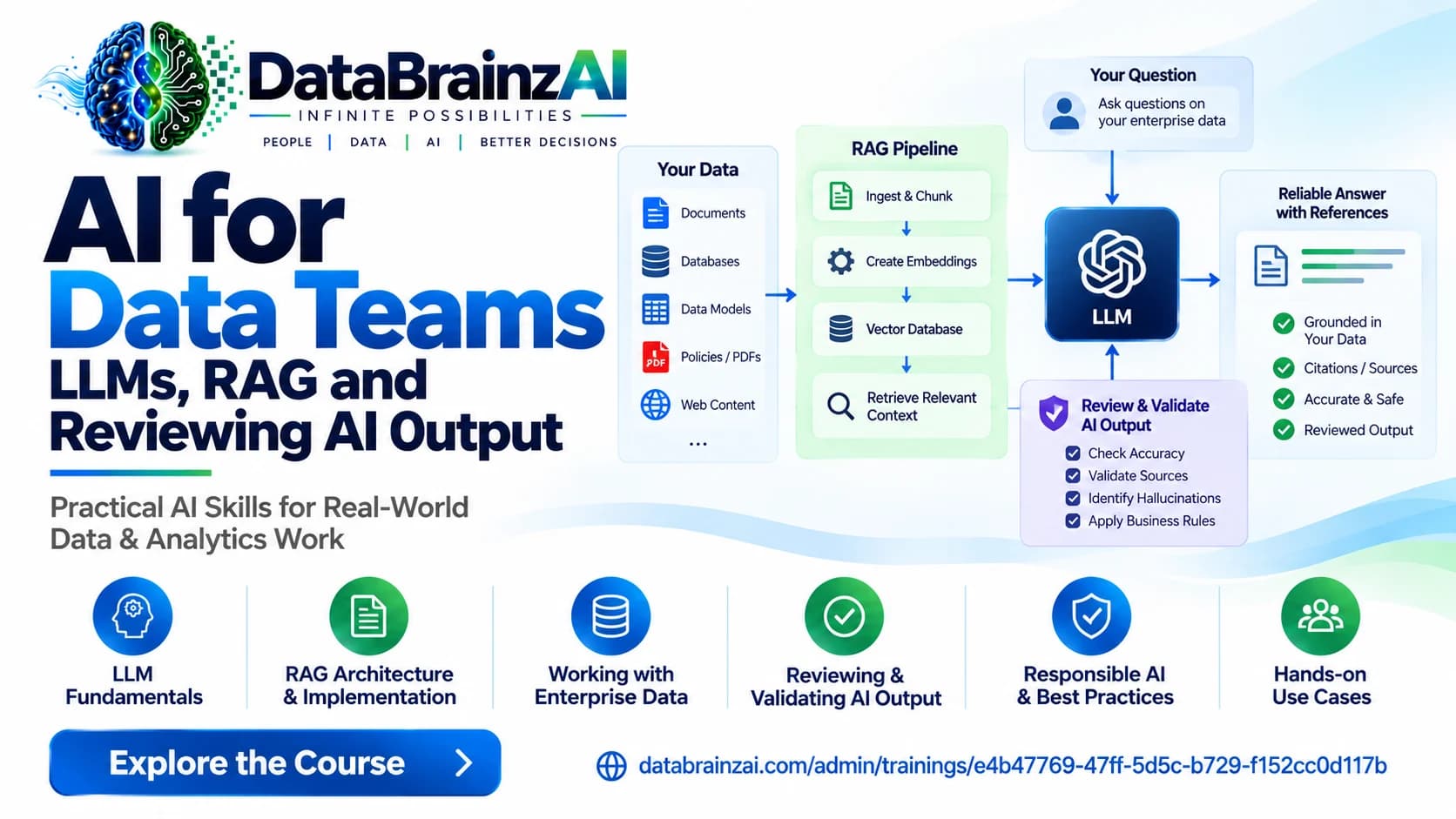
AI for Data Teams: LLMs, RAG and Reviewing AI Output
Artificial IntelligenceIntermediate

AI for Data Teams: LLMs, RAG and Reviewing AI Output

Use Generative AI effectively in data engineering | modeling | analytics and documentation | Explore LLMs | prompt engineering | RAG | vector search and responsible AI practices | Build prompts for SQL generation and data quality rules | Develop RAG pipeline using metadata.

Duration
16 hrs
Mode
Live online
Starts
20 Oct 2026
Syllabus · 4 modules · Sat–Sun, 10am–2pm IST
  1. LLM Basics for Data People · 3h
    • Introduction to Generative AI and LLMs

    • Traditional AI versus Generative AI

    • LLM architecture at a conceptual level

    • Tokens, tokenization and context windows

    • Training data, inference and next-token prediction

    • Model parameters and temperature

    • System prompts, user prompts and conversation context

    • Text generation and structured output

    • Strengths and limitations of LLMs

    • Hallucinations, outdated knowledge and ambiguous answers

    • Deterministic versus probabilistic outputs

    • Common use cases in data engineering, modeling and analytics

    • Overview of hosted and open-source LLMs

    • Responsible use of AI in enterprise environments

    • Ask an LLM to explain a complex SQL query.

    • Compare responses to the same prompt using different instructions.

    • Test how ambiguous business requirements affect generated answers.

    • Identify incorrect SQL and fabricated database objects in AI output.

  2. Prompting for Data Work · 4h
    • Prompt engineering fundamentals

    • Anatomy of a well-structured prompt

    • Role, task, context, constraints and output format

    • Zero-shot and few-shot prompting

    • Prompt templates and reusable prompt libraries

    • Structured outputs using JSON and tables

    • Prompting for SQL generation and explanation

    • Prompting for query debugging and optimization

    • Generating data dictionaries and technical documentation

    • Generating source-to-target mapping (STTM) drafts

    • Business requirement analysis and business rule extraction

    • AI-assisted entity and attribute identification

    • Iterative prompt refinement

    • Common prompt failure patterns

    • Generate SQL from a business question.

    • Generate table and column descriptions from database metadata.

    • Convert a business requirement into candidate entities and relationships.

    • Generate data quality rules from sample data.

  3. Retrieval and Vector Search · 4h
    • Limitations of LLMs when answering enterprise-specific questions

    • Introduction to Retrieval-Augmented Generation

    • RAG architecture and components

    • Document ingestion and preprocessing

    • Text extraction and cleaning

    • Chunking strategies and chunk size

    • Vector databases and vector indexes

    • Top-K retrieval

    • Metadata filtering

    • Context construction and prompt augmentation

    • RAG response generation

    • Basic RAG evaluation

    • Retrieval failures and incomplete context

    • Split documents into chunks.

    • Generate embeddings using an available embedding model.

    • Store and retrieve embeddings using a vector store.

    • Build a simple question-answering pipeline over metadata.

    • Compare ordinary LLM answers with RAG-grounded answers.

  4. Safe use and review · 5h
    • Responsible AI in data teams

    • Data privacy and confidentiality

    • Personally identifiable information (PII)

    • Sensitive data and enterprise data policies

    • Risks of sharing proprietary metadata

    • Safe use of public versus enterprise AI tools

    • Access control and data minimization

    • Prompt injection and untrusted retrieved content

    • Reviewing AI-generated SQL

    • Reviewing AI-generated data models and documentation

    • SQL execution, testing and reconciliation

    • Hallucination detection and factual verification

    • AI governance and auditability

    • Limitations of automated evaluation

    • Capstone project presentation and trainer review

    • Review an AI-generated SQL query and identify errors.

    • Identify sensitive information in sample prompts.

    • Evaluate RAG answers for relevance, correctness and source support.

    • Design a human approval workflow for AI-generated data artifacts.

You will be able to:
  • Explain how LLMs work, including tokens, context windows, embeddings and model limitations.

  • Identify hallucinations and other common failure modes in AI-generated content.

  • Design structured prompts for SQL generation, data documentation and data quality tasks.

  • Use AI to generate and review SQL queries, transformation logic and source-to-target mapping drafts.

  • Create prompts that support business requirement analysis and data modeling.

  • Explain embeddings, chunking, vector databases and semantic search.

  • Build a basic RAG pipeline over metadata and technical documentation.

  • Retrieve relevant information and generate context-grounded responses.

  • Evaluate AI-generated SQL, documentation and metadata using systematic review checklists.

  • Identify sensitive information and apply appropriate data protection practices.

  • Establish human review gates for AI-assisted data development.

  • Deliver a practical AI-assisted data project with documented testing and validation.

₹21,999per participant, + GST
Business Requirement to Enterprise Data Architecture
Enterprise Data ArchitectureAdvanced

Business Requirement to Enterprise Data Architecture

Enables experienced data engineers to solve multiple business problems of different roles like: Business Analyst (Requirement Gathering) | Data Architecture (Design Data Layers), | Data Modeler (Design Data Structures) with the help of AI as the core executor.

Duration
24 hrs
Mode
Live online
Starts
10 Nov 2026
Syllabus · 8 modules
  1. Business Requirements & Analysis · 2.5h
    • Introduction to enterprise data architecture

    • Business requirements versus functional and non-functional requirements

    • Role of the Business Analyst, Data Architect, Data Modeler and Data Engineer

    • Relationship between business architecture, application architecture and data architecture

    • Challenges in translating business language into technical solutions

    • Requirement gathering techniques

    • Business requirement documents (BRDs)

    • Functional and non-functional requirements

    • Business process identification

    • Business scenarios, use cases and user stories

    • Requirement classification and prioritization

    • Requirement ambiguity, duplication, inconsistency and gaps

    • Business events and their lifecycle

    • Business rules and decision points

    • Operational versus analytical requirements

  2. Business-to-Data Requirements · 3h
    • Business domains and subdomains

    • Data domain ownership

    • Master, reference, transactional and event data

    • Cross-domain data dependencies

    • Translating business activities into data requirements

    • Business objects versus data entities

    • Identifying data capture, update, retrieval and reporting requirements

    • Data attributes and business definitions

    • Data ownership and authoritative sources

    • Data retention and historical requirements

    • Operational, analytical and regulatory data needs

    • Source system identification

    • Source-to-business data mapping

    • Structured, semi-structured and unstructured data

    • Data profiling and source data assessment

    • Identifying missing, duplicate and conflicting data

    • Source system assessment and gap analysis

  3. Enterprise Data Architecture Fundamentals · 3h
    • What is enterprise data architecture?

    • Data architecture principles and standards

    • Centralized, decentralized and federated architectures

    • Enterprise data architecture building blocks

    • Data architecture patterns

    • Data architecture artifacts and documentation

    • Landing and staging layers

    • Bronze, Silver and Gold architecture

    • Enterprise Data Warehouse architecture

    • Operational Data Store (ODS)

    • Data Lake and Lakehouse

    • Data marts and semantic layers

    • Batch versus streaming architecture

    • Data integration patterns

    • ETL versus ELT

    • API-based and event-driven integration

    • Data replication and CDC

    • Data transformation and enrichment

    • Error handling and recovery

    • Data latency and integration SLAs

  4. Conceptual and Logical Data Modeling · 3h
    • Purpose of conceptual data models

    • Identifying business entities

    • Business entity relationships

    • Relationship types and cardinality

    • Enterprise conceptual data modeling

    • Logical data modeling methodology

    • Entities, attributes and relationships

    • Primary keys, alternate keys and candidate keys

    • Foreign keys and referential integrity

    • Identifying, non-identifying and recursive relationships

    • Associative entities and many-to-many relationships

    • Normalization: 1NF, 2NF and 3NF

    • Enterprise-wide entity reuse

    • Common business entities and shared data structures

    • Master data and reference data modeling

    • Transaction, event and status modeling

    • Effective dating and historical attributes

    • Address, contact and party modeling

    • Hierarchies and recursive relationships

    • Modeling complex business relationships

    • Model validation and quality checks

    • Logical model review and stakeholder approval

  5. Enterprise Data Modeling Approaches · 3h
    • Introduction to dimensional modeling and Kimball methodology

    • Star schema and snowflake schema

    • Fact tables and dimension tables

    • Identifying business processes and fact table grain

    • Transaction, periodic snapshot and accumulating snapshot facts

    • Conformed dimensions

    • Role-playing, junk and degenerate dimensions

    • Slowly Changing Dimensions (SCD Types 0, 1, 2 and 3)

    • Introduction to Data Vault 2.0 architecture

    • Business Vault versus Raw Vault

    • Hub, Link and Satellite structures

    • Business keys and hash keys

    • Satellite historization and load tracking

    • Effectivity and record tracking satellites

    • Multi-active satellites

    • Point-in-Time (PIT) and Bridge tables

    • Enterprise data warehouse integration patterns

    • Data Vault to dimensional data mart transformation

    • Hybrid enterprise data architecture

  6. Physical Architecture and Data Platform Design · 3h
    • Logical versus physical data models

    • Mapping logical entities to physical tables

    • Indexing and partitioning strategies

    • Denormalization and performance considerations

    • Database-specific implementation considerations

    • Forward and reverse engineering using ER/Studio

    • Data warehouse, data lake and Lakehouse architecture

    • Cloud data platform design considerations

    • Cloud storage and compute separation

    • Data ingestion and transformation services

    • Data platform scalability and elasticity

    • Platform selection based on business and technical requirements

    • Batch and streaming processing architecture

    • Data storage design and lifecycle

    • Data partitioning and clustering

    • CDC and historical data management

    • Data transformation architecture

    • Query performance and workload optimization

    • Data retention and archival

    • Technical architecture decisions and trade-offs

  7. Data Governance, Integration and Lineage · 3h
    • Data governance framework

    • Data ownership and stewardship

    • Data governance operating model

    • Business glossary and data dictionary

    • Technical and business metadata

    • Master data management (MDM)

    • Reference data management

    • Data classification and sensitive data identification

    • Data quality rules and validation

    • Data profiling and reconciliation

    • Data privacy and security principles

    • Role-based and attribute-based access control

    • Data masking and encryption

    • Personally identifiable information (PII) classification

    • Data retention and deletion requirements

    • Regulatory and audit requirements

    • Source-to-target mapping (STTM)

    • Transformation rules and derivation logic

    • Data lineage: source to report

    • Data reconciliation and auditability

    • ETL/ELT specifications

    • Documentation and traceability

  8. AI-Assisted Architecture and Capstone Project · 3h
    • Introduction to AI-assisted data architecture

    • AI-assisted BRD analysis and requirement extraction

    • Prompt engineering for business requirement analysis

    • Identifying entities, attributes and relationships using AI

    • Generating business rule catalogues

    • AI-assisted conceptual and logical model generation

    • AI-assisted source-to-target mapping

    • Analyze the business requirements and processes.

    • Identify business domains, entities and business rules.

    • Design the enterprise data architecture.

    • Develop a Data Vault and dimensional model for selected processes.

    • Prepare data flows, STTM and lineage.

    • Prepare the implementation blueprint.

    • Enterprise architecture walkthrough

    • Conceptual and logical model review

    • Data integration and modeling strategy review

    • Architecture decision documentation

    • Capstone project presentation

    • Final assessment and course completion

You will be able to:
  • Business Requirement Analysis.

  • Business-to-Data Mapping.

  • Enterprise Data Architecture Design.

  • Enterprise Data Modeling.

  • Dimensional Modeling.

  • Data Vault 2.0 Modeling.

  • Cloud Data Platform Architecture.

  • Data Integration and Lineage.

  • Data Governance and Quality.

  • AI-Assisted Data Architecture.

  • Architecture Documentation.

  • End-to-End Architecture Delivery.

₹19,970per participant, + GST
Professional career upgradation

Build the next stage of your data career.

Many professionals know the tools but need broader skills in business, architecture, modeling and solution design to move into senior roles. AI helps you prepare faster. Career decisions stay with you and your mentor.

  1. STEP 1
    Data Engineer
  2. STEP 2
    Data Modeler
  3. STEP 3
    Data Architect
  4. STEP 4
    Enterprise Data Architect
Our training model
30% concepts
70% hands-on, real business scenarios
Your journey
01
Skill assessment
AIStructured self-assessment and CV reviewMentorHonest calibration of where you stand
02
Skill gap analysis
AICompares your profile with the target roleMentorWhich gaps matter most for you
03
Learning roadmap
AIDrafts a week-by-week planMentorAdjusts it to your goals and time
04
Portfolio project
AIScaffolds a realistic project and datasetMentorDesign review so it is interview-ready
05
Interview preparation
AIPractice questions and drillsMentorReal design interviews and feedback
06
Mentoring
Mentor1:1 guidance on architecture, modeling, cloud and career moves
Book a career consultation
From idea to implementation

Ten steps. Five human gates.

AI accelerates every step. A person approves at every marked gate before work moves on.

01UnderstandAI-assisted
02AnalyseAI-assisted
03 · GATEArchitectExpert approval
04 · GATEModelExpert approval
05DesignAI-assisted
06 · GATEBuildCode review
07 · GATETestUser acceptance
08 · GATEDeployChange approval
09EnableAI-assisted
10ImproveAI-assisted
Technology expertise

Technology-neutral. Chosen for your requirement.

Cloud
Azure, AWS
Data platforms
Snowflake, Databricks, Microsoft Fabric
Databases
Oracle, SQL Server, PostgreSQL
Data engineering
Python, SQL, ETL / ELT, dbt
Modeling
ER/Studio, ERwin, Oracle Data Modeler
Analytics
Power BI, Data Warehouse, Dimensional Modeling
Architecture
Data Vault 2.0, Lakehouse, Data Warehouse, Enterprise Data Architecture
AI in data work
Snowflake Cortex, Databricks assistants, Fabric Copilot, dbt Copilot, enterprise LLMs, RAG, vector search

The stack is selected based on the business requirement, never forced onto one technology.

Trust, data protection and responsible AI

Your data. Your decisions. Our accountability.

We work with business-critical and often personal data. Clear rules govern how we use AI, so speed never costs you accuracy, privacy or control.

01 · Approval

Human approval at every gate

Requirements, architecture, models, code and releases are approved by a named, qualified person.

02 · Access

Least-privilege AI

AI tools work on metadata, masked or synthetic data by default. Real personal data needs your written approval.

03 · Training

No training on your data

We use enterprise AI services with no-training terms, or models hosted inside your cloud.

04 · Audit

Everything is traceable

We log which outputs were AI-assisted, who reviewed them and what changed.

05 · Control

Override and stop

Any team member can reject an AI output or pause AI use on a project at any time.

06 · Rigour

Guarding against over-trust

Reviewers are trained to check AI output critically, not rubber-stamp it.

Our delivery practices are designed to help clients meet India's Digital Personal Data Protection Act, 2023 and DPDP Rules, 2025, and align with international practice such as the EU AI Act's human-oversight principles, ISO/IEC 42001 and the NIST AI Risk Management Framework.

Engagement models

Work with us the way that fits.

ModelWhat you get
ConsultingArchitecture and technical advice for specific requirements
Assessment SprintFixed-scope review of your platform or plan, AI-assisted analysis, expert-written report
Project SupportHands-on delivery support across implementation
Corporate TrainingCustomised team capability programs
Individual TrainingInstructor-led professional development
Technical MentoringOne-to-one or small-group guidance
Product DevelopmentData + AI enabled applications
Technical SupportHelp with data problems, architecture issues and implementation challenges
Products · in development

Accelerators we are building.

Data Platform Automation

Metadata-driven frameworks for faster platform development.

Data Modeling Utilities

Accelerators for modeling, Data Vault, STTM, metadata, data quality and lineage.

AI-Assisted Data Solutions

Help with requirements, modeling, documentation, classification and data quality, with review built into the workflow.

Mobile Data Applications

Practical apps for data-driven personal and business workflows.

Have a data challenge?

Tell us what you're trying to solve.

Architecture, modeling, platform delivery, team upskilling, career growth or a Data + AI app. We'll help you work out:

  • What should be built, and how it should be architected
  • Which technologies to consider and how to model the data
  • How to enable your team
  • Where AI can safely add value
  • How the solution can evolve over time